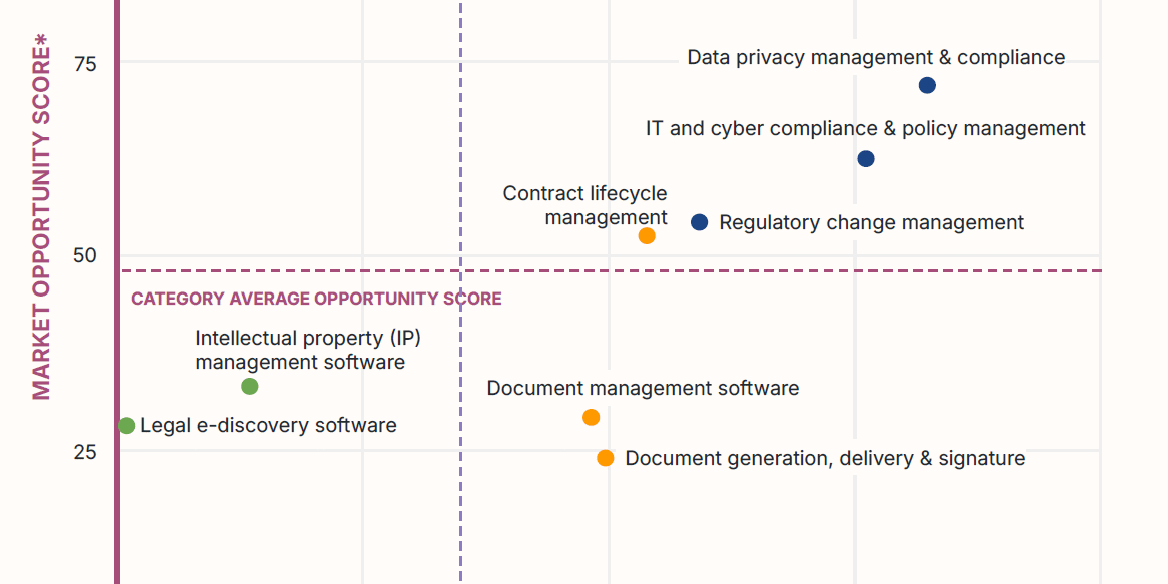
In 2025, the Legal and Document Tech market is shaped by three main forces: the growing complexity of regulations, the maturity of AI-driven tools, and increasing pressure on operational efficiency. Based on the Qualitate report “The State of Legal and Document Tech: The Winning Playbook for 2025”, we highlight key technical trends for legal professionals, GRC specialists, compliance officers, and LegalTech developers.
- Market Architecture: Three Core Pillars
1.1 Document & Contract Management (DCM) – Digitization of document workflows and contracts, including Contract Lifecycle Management (CLM), e-signatures, templating, and version control. Key players: DocuSign, Adobe, Microsoft.
1.2 Data Security & GRC – Risk, compliance (GDPR, CCPA, HIPAA), sensitive data storage, and access control. Key vendors: OneTrust, BigID, TrustArc.
1.3 Legal & IP Operations – Managing IP rights, legal analytics, and litigation tracking. This segment remains under-automated but holds strategic potential in verticals like healthtech and fintech.
- High-Velocity Budget Areas (Next Twelve Months Spend Acceleration)
Notable growth is observed in:
- IDP (Intelligent Document Processing) – Automating document recognition, classification, metadata extraction, and contract triggers.
- Data Privacy Management – Real-time compliance monitoring and enforcement.
These domains yield high ROI by reducing manual workload and mitigating legal risks. The shift is toward compliance-by-default systems.
- Maturity vs. Potential Matrix: Product and Investment Priorities
- High Growth, Low Maturity: IDP, PrivacyOps, Automated Risk Mapping
- Stagnant, High Maturity: E-discovery, Legal Practice Management (LPM)
- Moderate Potential: CLM and Policy Automation
Key evaluation metrics:
- High Evaluation Rate (strong pre-sales interest)
- Low Decided-Against Rate (minimal drop-off post-pilot)
- High Replacement Potential (willingness to replace legacy systems)
- Player Strategies: Consolidation vs. Niche Domination
- Public vendors (e.g., Adobe, Microsoft): focus on platform strategy and ERP/CRM integration.
- Private players: win in micro-niches like data lineage, consent management, and automated policy auditing.
Winning product attributes:
- API-first architecture
- Flexible data models (ontology + tagging)
- Full support for traceability, audit logs, and retention policies
- Regulatory Turbulence: From GDPR to DPD and the AI Act
- Frameworks like GDPR, CPRA, LGPD, and DPD create a multi-jurisdictional compliance landscape.
- Success depends on flexible data architectures and policy automation.
Key focus areas:
- PrivacyOps
- Automated breach response
- Real-time DPIAs (Data Protection Impact Assessments)
Conclusion: RegTech integration is no longer optional, especially in regulated verticals such as fintech, biotech, medtech, and edtech.
- Underserved Segment: LegalTech for SMEs and the Midmarket
Firms with <500 employees:
- ~70% of LegalTech solutions don’t meet their needs
- Processes are simpler but pressure from regulations is increasing (especially in the US and EU)
- Require low-code/no-code interfaces, minimal TCO, and onboarding < 2 weeks
Opportunity: lightweight, modular LegalTech tools (e.g., CLM Lite, Consent SDKs).
- Recommendations for Vendors, Buyers, and Investors
For developers/vendors:
- Build with Privacy-by-Design and Explainable AI
- Prioritize predictive analytics (e.g., contract risk scoring)
- Simplify integration via REST APIs and prebuilt connectors
For corporate buyers:
- Re-evaluate your legal tech stack — prioritize IDP and PrivacyOps
- Transition from manual audits to real-time compliance monitoring
- Be open to high-velocity emerging vendors
For investors:
- Focus on market pull over pure tech push
- Avoid segments with high stickiness and low replacement likelihood
- Back teams with domain expertise and lightweight architecture