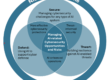
As artificial intelligence becomes an integral part of modern infrastructure, its implementation brings not only new opportunities but also a wide spectrum of cyber risks. The document “Critical AI Security Guidelines” offers a structured approach to understanding these risks and applying practical security measures. This article summarizes the core principles and actions necessary to establish robust, secure AI systems.
1. Access Control and Model Protection
AI systems operate across complex environments involving users, APIs, vector databases, and agents. It’s vital to enforce the principle of least privilege not just for human users, but also for every service that interacts with AI models.
Model files themselves are sensitive assets. Protecting them requires a combination of:
-
Encryption
-
Trusted Execution Environments (TEE)
-
Obfuscation
-
Digital signatures
With AI models now acting as autonomous agents within business processes, a Zero Trust Architecture is not optional — it is the new standard.
2. Data Integrity and Training Security
A compromised training dataset can poison an entire model, making it behave unpredictably or maliciously. This is particularly dangerous in Retrieval-Augmented Generation (RAG) systems, where the integrity of vector databases directly influences model output.
To secure data pipelines:
-
Harden ingestion pipelines with validation and pre-processing
-
Implement content signing and audit mechanisms
-
Separate read and write permissions for data access
These measures prevent unauthorized data injection and manipulation during training and inference stages.
3. Local vs Cloud-Based Deployment
Choosing between on-premise and cloud deployment is a key architectural decision with security implications.
-
On-premise: Offers maximum control but increases operational complexity and costs.
-
Cloud platforms: Offer scalability and ease of use but raise concerns over data logging, retention policies, and secondary usage of data for training.
A strong contractual framework is essential, including explicit prohibitions on data usage by the provider.
4. Inference Security
Modern AI models, especially large language models (LLMs), are vulnerable to prompt injection attacks, where malicious inputs manipulate model behavior or bypass intended constraints.
Defensive measures include:
-
Layered input and output filtering
-
Isolating user and system prompts
-
Employing a secondary LLM to validate outputs before returning them to users
These steps reduce the likelihood of AI models being tricked into harmful or unauthorized behavior.
5. Monitoring and Behavioral Analytics
Security does not end with deployment. AI observability is critical and should go beyond standard input-output logging.
Security teams should monitor:
-
API usage anomalies
-
Unexpected token generation patterns
-
Refusals to answer questions
-
Behavioral deviations over time
This behavioral telemetry should be integrated into SIEM platforms and linked to broader anomaly detection strategies.
6. Governance, Risk, and Compliance (GRC)
AI regulations are evolving rapidly. Enterprises must prepare for and align with new legal frameworks such as:
-
EU AI Act
-
Executive Order 14110 (U.S.)
-
MITRE ATLAS Framework
-
OWASP Top 10 for LLMs
Security governance should include:
-
AI Bill of Materials (AIBOM) — a record of models, training data sources, and dependencies
-
Model Registry — for versioning, auditability, and rollback
-
AI GRC Board — a cross-functional body for oversight of AI adoption and risk review
Final Thoughts
As AI adoption accelerates, the risks it brings cannot be an afterthought. Security leaders must treat models not as static artifacts, but as evolving, interactive agents that demand the same — or even greater — level of protection as traditional digital assets. By applying the principles outlined above, organizations can move toward AI systems that are not only powerful, but trustworthy.